
We’re proud to feature our very own Francesca Carter in our “Lived and Learnt” series, who gave a heartfelt, insightful, and fun talk on dispelling myths surrounding trans people. She helps us build the understanding and confidence needed to engage in conversations and practice allyship.
In this article, she walks us through the 10 common myths surrounding trans people today, and how we can be a supportive ally to trans people in today’s world. Let’s dive in!
The first thing to note is that while this presentation is largely about debunking myths, it’s also worth pointing out that silence surrounding transgender people and a lack of open discussion on the topic can also be harmful. Fran was inspired to give this presentation following the recent ruling by the UK Supreme Court on biological sex, with the aim of helping to dispel some common myths and misinformation that have been circulating about transgender people in recent years and leading to increased discrimination.
Fran decided to come out in 2021 and identifies as a woman. She began hormone therapy in December 2022, but is still waiting for NHS treatment. Fran discusses how transitioning has truly improved her quality of life, well-being, and confidence.
She has noticed that people often want to be supportive, but they don’t know how to talk about it for fear of hurting someone’s feelings or causing offense.
And with that, this talk aims to spark conversation, understanding, and engagement! To do this, we’ll walk through 10 common myths surrounding the topic.
Let’s start by clarifying the difference between sex and gender and some related terminology. Sex has to do with our chromosomes and genitalia—in short, it’s about your body. Gender, on the other hand, is about how we feel and how we identify.
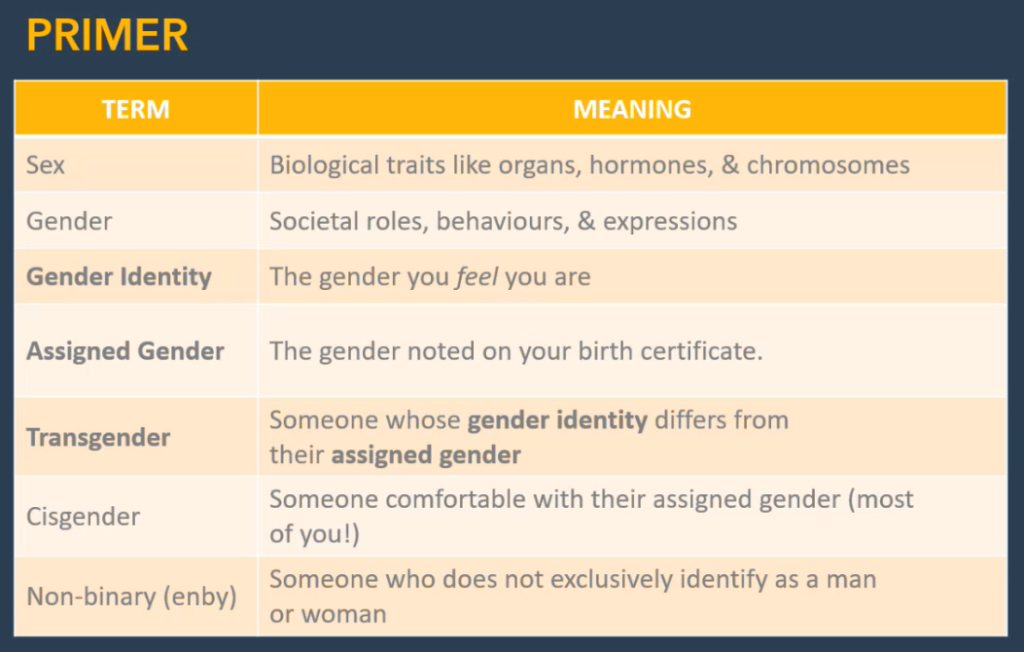
Now that we’ve clarified the terms, let’s move on to the 10 common myths!
Myth 1: Trans People Are Everywhere!
A lot of news coverage focuses on transgender people, and this is sometimes portrayed as a tsunami that is taking over society and shaping the minds of young people. In reality, transgender people are very much a minority. Out of every 200 people, roughly only 1 is transgender.
Some research has been conducted on how the news reinforces the idea that trans people are everywhere and causing harm. One example comes from the Daily Mail. Through January 2013, there were 6 articles about trans people, none of which were negative. Fast forward to January 2023, and there were 115 articles, and 87% of them were negative.
Overall, transgender people aren’t really a trend; much of it is simply people having the space to speak out and use vocabulary that just didn’t exist before. We should be mindful that there’s a potentially larger trend of people talking about it (often unkindly)! People write about us, but we’re rarely the ones doing the writing.
This is really a misconception. Proto-trans people have existed throughout history, and we use the term “proto” because we didn’t have the language or awareness that we have today.
But historically, there have been many examples of people who felt that their gender identity differed from the one assigned to them at birth. They range from rulers to saints and thinkers; some examples include:
We are much more aware of transgender people now and have a greater capacity to offer treatments such as hormone therapy than we did before, but this just goes to show that feeling a disconnect between the gender you were assigned at birth and the gender you identify with is by no means a new phenomenon.
Well, it is! The basis for treatment is gender dysphoria, which can be assessed by a psychologist. The medical consensus has also evolved over time; for example, homosexuality used to be considered a mental illness.
Historically, it’s also true that some countries have had trans communities for centuries, such as the Hijra of India.
We often hear this, especially when it comes to children. But it’s important to remember that the average person undergoing transition is already well into adulthood, and waiting lists are extremely long for any form of healthcare for transgender people—even by typical NHS standards.
Recent studies have shown that the average age at which a transgender person receives a diagnosis of gender dysphoria is 26—most people who transition aren’t children to begin with!
They often have to wait 3 to 7 years just for their first appointment. Then there’s more than a year for hormone replacement therapy, another year or more for a surgery referral, and then another year to 3 years for the actual surgery.
Regret rates, even for children, are very low (1 to 2%) for transgender people, and there is plenty of time for them to consider their decision to transition. It is quite astonishing that, for such a life-changing treatment, the regret rates are lower than those for most types of surgery, such as spinal or cosmetic surgery, for example.
A lot of media attention is focused on examples such as trans women using women’s restrooms, and the claim that this poses a threat to cis women.
For Fran, this was confusing, because trans women like herself had already been using women’s spaces without any trouble for decades, and she had never had anyone comment or make a scene about her presence in a particular restroom. We see that statistically, women tend to be more comfortable than men with the idea of trans people using public restrooms and facilities designated for their own gender.
This is supported by evidence as well! Countries with more lenient laws regarding gender identity and transgender people’s access to public spaces see no increase in crime rates against women before and after enacting these laws, which seems to debunk the idea that cis women would be threatened by equal access to public spaces. It’s important to remember that headlines can shape our perceptions of an entire group of people by magnifying individual, exceptional cases, whereas the statistics tell a truer, fairer story.
For the record, you can't! Cis women have been attacked—verbally and even physically—because people thought they were trans. Male staff and patrons have sometimes even entered women’s restrooms specifically for this purpose!
But that’s beside the point; it’s hurtful to make a big deal out of it. Transitioning is a personal matter, and who are we to judge someone’s appearance and gender identity? It marginalizes other people when, ultimately, we’re no different from anyone else.
Elliot Page is a great example of someone who has transitioned publicly during their acting career, starring in famous roles before, during, and after their transition. Whether or not you think you could tell this based purely on appearances, the fact that he is a trans man and was assigned female at birth shouldn’t be used as a “gotcha!” moment. It is simply one aspect of his identity and who he is as a person.

Criticism isn’t censorship. It’s true that trans people and their allies are advocating for trans rights, inclusivity, and well-being. Misinformation is rampant, and it’s often the case that the voices of trans people themselves are filtered out of the public discourse.
Take, for example, the UK Supreme Court’s recent ruling on public spaces and the use of biological sex to define women; in that decision, no trans women or advocates were consulted regarding the deliberations on trans women in public spaces, despite the fact that it directly affects their lives more than anyone else’s. If this isn’t the definition of being silenced, what is?
We want equal access, not special treatment! We want free healthcare and to be able to use the restroom in peace! It’s safe to say that it’s not the norm to have to debate with yourself whether it’s safe to use a public restroom or to be on waiting lists for even the most basic treatments that can last nearly a decade.
Other groups are protected on the basis of religion, age, disability, race, and other factors; we’re simply asking for the same kinds of protections.
Well, hopefully not.
On the surface, trans rights seem to be in a tough spot right now in the UK, but we’ve been here before with the rights of lesbian, gay, and bisexual people before they were widely accepted. UK legislation tends to lag behind society’s views.
Public support for transgender people is stronger than people might think based on the content they see from algorithms, which are often designed to stoke tensions. But when asked directly, positive support for transgender rights outnumbers negative sentiments four to one.
And despite the Supreme Court's rulings and the negative press, people are fighting back, and grassroots support is growing. Recently in London, over 100,000 people attended the Trans+ Pride rally in 2025!
I hope this has changed that a bit! Above all else, it’s not about what you know or believe—it’s about your intent. If you’re looking to understand, you won’t go far wrong.
And on that note, listening can be more helpful than speaking. There’s no shortage of people who try to put words in our mouths, and if you listen to understand, you’ll do better than most!
But if you want to speak up and ask questions, that’s great, too. We need to strike a balance between listening and genuine engagement so that silence doesn’t cause more harm.
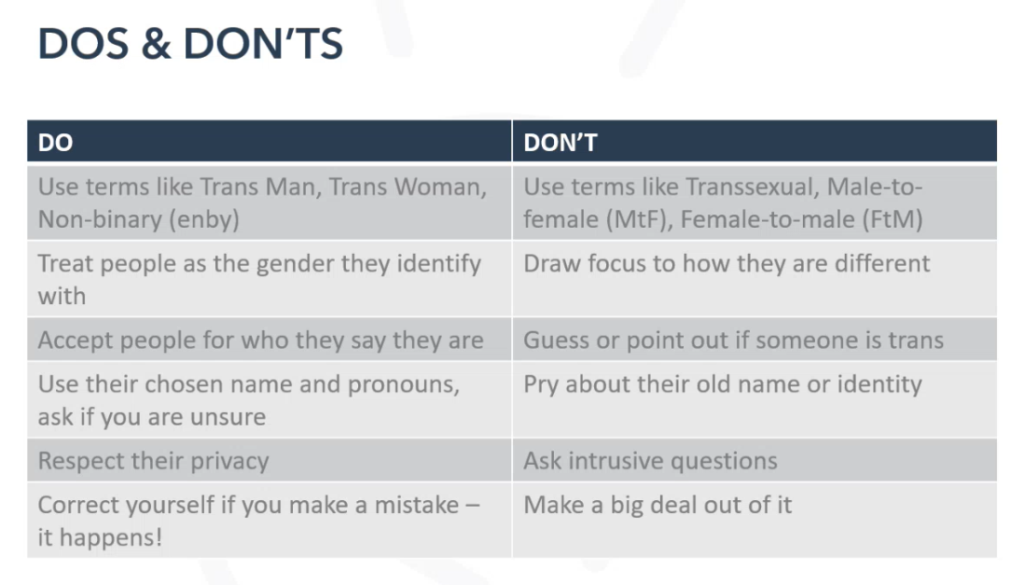
This advice can also be applied to any marginalized group in society:
Some recommended books include:
Donations and causes: